How to Build a Gym Sales Funnel That Actually Converts
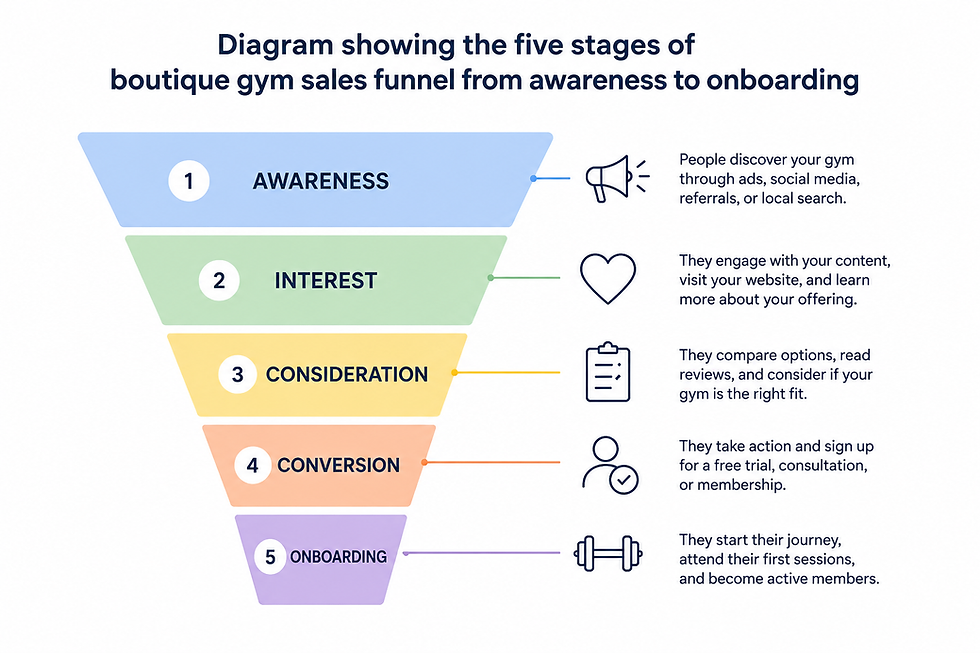
A gym sales funnel turns strangers into paying members through five stages: awareness, lead capture, nurture, conversion, and onboarding. The gyms with the best conversion rates aren't the ones with the biggest ad budgets. They're the ones whose funnels don't leak between stages. This guide breaks down how to build each stage, the metrics that matter, and the tech setup that keeps the whole thing running while you coach.
Most boutique gyms don't have a sales funnel. They have a website, a Facebook page, and a hope that someone walks in the door. That's not a funnel. That's a wish.
A real gym sales funnel is a deliberate path that takes a stranger from never having heard of your gym to handing you a card on autopay. It has stages, metrics at each stage, and a system that catches what falls through the cracks. Building one isn't complicated, but it does require thinking about your gym like a business, not just a coaching practice.
Here's how to build a gym sales funnel that converts.
What is a gym sales funnel?
A gym sales funnel is the structured journey a prospect takes from first awareness of your gym to becoming a paying member. The word funnel describes the shape: a lot of people enter at the top, fewer make it through the middle, and a smaller, more qualified group becomes members at the bottom.
Every gym has a funnel whether they designed one or not. The question is whether yours is intentional or accidental. Intentional funnels convert at 20 to 30 percent. Accidental funnels convert at 5 to 10 percent and the owner can't explain why.
The five stages of a gym sales funnel
Every effective gym funnel has the same five stages. They show up in different forms at different gyms, but the underlying structure is consistent.
Stage 1: Awareness
Awareness is when a stranger finds out your gym exists. This is your top-of-funnel: social media, local SEO, paid ads, referrals, partnerships, signage. The job of awareness content is not to sell. The job is to make the prospect aware that your gym solves a problem they have.
Awareness metric to track: monthly reach across all channels combined.
Stage 2: Lead Capture
Lead capture is the moment a prospect gives you their contact information. This usually happens through a website form, an ad landing page, a DM conversation, or a walk-in. The goal at this stage is to make giving you contact info feel low-risk and high-value.
The best capture mechanisms in 2026 are: a clear paid intro offer with a short form, a free downloadable guide tailored to your gym type: Here's an example of Chalk It Pro's Growth Guide: https://storage.googleapis.com/msgsndr/t9nxWvxWX1x8Mns9mKIp/media/69271c6663b30fa07e7e0641.pdf, or a calendar booking link for a no-sweat intro consultation.
Lead capture metric to track: lead capture rate (leads divided by ad clicks or site visits). For paid ads, aim for 8 to 15 percent. For organic, the rate will be lower but the leads are typically warmer.
Stage 3: Nurture
Nurture is the bridge between lead capture and conversion. It's the most ignored stage and the most expensive one to skip. The first 48 hours after lead capture decide whether the prospect ever shows up.
An effective gym nurture sequence in 2026 looks like this: an automated text and email within 5 minutes of opt-in, a personal text or call within 24 hours, an automated reminder 48 hours later, and a longer-form value email 72 hours later. After the first week, the lead moves to a longer cadence (weekly) until they either book or unsubscribe.
Nurture metric to track: lead-to-booked-trial rate. A healthy gym hits 40 to 60 percent here.
Stage 4: Conversion
Conversion is the moment a lead becomes a paying member. Most boutique gyms convert through a specific in-person or virtual sales conversation, typically called a No Sweat Intro, a Goal Review, or a Foundations Consultation. The name varies. The structure is the same: understand the prospect's goals, propose a path, present pricing, and ask for the commitment.
The biggest mistake at this stage is skipping the consultation and trying to sell on the gym floor. The gyms with the highest conversion rates have a dedicated sales conversation, on calendar, with a defined script (not a robotic one, but a consistent one).
Conversion metric to track: trial-to-paid conversion rate. Aim for 60 to 80 percent if your trial includes a proper sales conversation.
Stage 5: Onboarding
Onboarding is where a new member becomes a long-term member. It's part of the funnel because retention drives lifetime value, and lifetime value drives what you can spend on the top of the funnel. A great onboarding flow includes the first call welcome, the first class checklist, the 7-day check-in, the 30-day goal review, and the 90-day milestone celebration.
We dig into the full onboarding system in: https://www.chalkitpro.com/post/gym-revenue-streams
Onboarding metric to track: 90-day retention rate. Healthy boutique gyms retain 80 to 90 percent of members past the 90-day mark.
How does a gym sales funnel compare across stages?
Stage | Goal | Key Metric | Healthy Benchmark |
Awareness | Make your gym visible | Monthly reach | 5,000+ per month (boutique) |
Lead Capture | Get contact info | Capture rate | 8-15% from paid traffic |
Nurture | Get the prospect to show up | Lead-to-trial rate | 40-60% |
Conversion | Get the trial to pay | Trial-to-paid rate | 60-80% |
Onboarding | Keep the new member | 90-day retention | 80-90% |
Common gym sales funnel mistakes
• Pouring money into awareness with no capture system. An ad that drives traffic to a generic homepage converts at one or two percent. The same ad driving to a tight landing page converts at ten.
• Capturing leads with no nurture. The lead opts in, gets one auto-email, and never hears from you again. This is the most expensive mistake in gym marketing.
• Trying to sell on the gym floor instead of in a dedicated conversation. The 10-minute chat after class is not a sales conversation. Schedule the consultation.
• Ignoring onboarding. A great funnel that delivers members who quit in three months is a leaking funnel, just leaking at the bottom.
• Running the whole thing on paper or in a shared inbox. Once you're past 20 leads a month, the manual system breaks.
The tech stack you need to run a gym sales funnel in 2026
You can run a basic funnel with a website, a calendar tool, an email tool, and a phone. That works up to about 20 leads a month. Beyond that, the manual coordination breaks down and you start losing leads to bad timing.
A modern gym management platform handles the same jobs in one place: lead capture forms on your site, automated nurture sequences via email and text, calendar booking for sales conversations, conversion tracking, and onboarding workflows. Chalk It Pro+ will have your connected automations and example workflows for you to utilize and customize. We've created a ton of amazing tools to help you automate some of these important processes with also feeling like they are personal to your clients as well. Having these workflows do work for you, and allow you to concentrate on the growth of your business it a huge cheat code.
How to build your gym sales funnel this month
1. Map your current funnel. Write down every step a prospect takes from first hearing about your gym to handing you a card. If you can't write it down, you don't have a funnel.
2. Identify your biggest leak. Look at the numbers (or estimate them honestly) and find the stage with the worst drop-off. That's where you fix first.
3. Build one new automation. Pick the most leaky stage and add one automated step. If your nurture is the leak, build a 5-minute auto-text. If your booking is the leak, add a calendar link.
4. Define your sales conversation. Write down the structure of your intro consultation. Five sections at most. Goals, history, recommendation, pricing, commitment.
5. Measure weekly for 90 days. Track leads in, leads booked, trials shown, trials paid, members retained at 30 days. Adjust based on what the numbers show.
Frequently Asked Questions
What's the difference between a gym sales funnel and a marketing funnel?
A marketing funnel includes everything from awareness through conversion. A sales funnel typically refers to the middle and bottom: lead capture, nurture, conversion, and sometimes onboarding. In practice, the terms get used interchangeably at most boutique gyms.
How long should it take a prospect to go through a gym sales funnel?
Most prospects move from first awareness to paid member in 7 to 21 days when the funnel is dialed in. Cold leads can take 30 to 60 days. Referral leads often close within a week.
Should I use a separate CRM tool or my gym management software for the funnel?
Separate tools work but create coordination problems. The lead in your CRM has to manually become a member in your gym software, and the data doesn't follow. A unified platform is faster and less error-prone once you're past 15 to 20 leads per month.
What's the most important stage of a gym sales funnel?
Nurture. The middle stage is where most gyms lose the most leads, and it's the cheapest to fix. A great awareness campaign with no nurture wastes ad spend. A weak awareness campaign with great nurture still produces members.
How do I track gym sales funnel performance?
Track five numbers weekly: leads captured, leads who booked a trial, trials who showed, trials who paid, and members retained at 30 days. Most gym management platforms with CRM functionality will track these automatically.
Can I run a gym sales funnel without paid ads?
Yes. Referral programs, local SEO, organic social, and community partnerships can fill the top of the funnel without paid spend. The bigger question is speed: paid ads accelerate the timeline, organic channels take longer.
Ready to see what's possible? Chalk It Pro is built to run your entire gym. Book a demo call at www.chalkitpro.com/bookdemo |
About the Author
Nate Steele is the co-founder and CEO of Chalk It Pro, as well as active gym owner of CrossFit 630 in Naperville, IL. He built Chalk It Pro because he was tired of running his gym on four different tools that didn't talk to each other. He still coaches every week.