Free Trial vs. Intro Offer: Which Converts More Gym Members?
Gym free trial vs intro offer
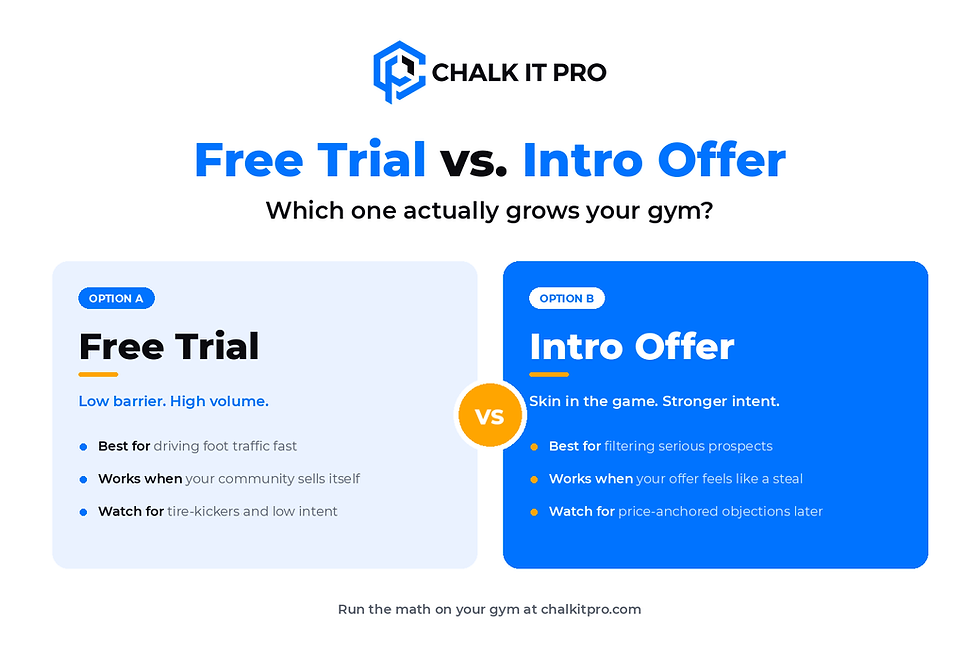
Free trials get more leads in the door. Paid intro offers convert more of those leads into long-term members. For most boutique gyms with strong programming and a sales conversation, a paid intro offer (between $39 and $99 for two weeks to one month) converts at 60 to 80 percent versus 30 to 45 percent for free trials. The exception: high-volume, low-touch fitness models, where free trials can outperform.
If you've ever spent a Sunday afternoon arguing with your business partner about whether your gym should run a free trial or a paid intro, you're not alone. It's one of the most common debates in boutique fitness, and both sides have a case.
Free trials feel more accessible. They bring in more leads. They're easier to promote. Paid intro offers feel like more friction up front, but they convert better and attract a more serious prospect. The right answer for your gym on the topic of gym free trial vs intro offer depends on your model, your price point, and how strong your nurture and sales conversation are.
Here's the honest breakdown.
What is a free trial at a gym?
A free trial is exactly what it sounds like: a prospect attends one or more classes or sessions at no cost. The trial period varies. Some gyms offer a single free class. Others offer a free week or two.
The pitch to the prospect is simple: try us before you commit. The pitch to the gym owner is volume: free trials lower the barrier and bring more people through the door.
What is a gym intro offer?
A gym intro offer is a paid introductory package, typically priced between $39 and $99, that gives a prospect access for a limited period (one to four weeks) or a defined number of sessions (5 to 10). The price is significantly below regular membership but high enough to require a commitment.
Common intro offer formats: a paid two-week unlimited trial, a four-week foundations package, or a 10-session intro punch card.
Free trial vs. intro offer: the side-by-side
Factor | Free Trial | Paid Intro Offer |
Lead volume | Higher (30-60% more leads) | Lower (more qualified) |
Show-up rate | Lower (50-65%) | Higher (85-95%) |
Trial-to-paid conversion | 30-45% | 60-80% |
Cost per acquired member | Higher | Lower |
Best for | High-volume models, group fitness chains, pure boutique studios | Boutique gyms with strong programming and a sales conversation |
Prospect mindset | Curious, browsing, possibly comparing | Committed, qualified, ready to start |
Why paid intro offers convert better at most boutique gyms
The math is counterintuitive at first. You're charging the prospect, which means fewer people opt in. So how is the paid offer the higher-converting choice?
Three reasons. First, money creates commitment. A prospect who paid $49 is more likely to show up to class than one who paid nothing. Show-up rate is the leading indicator of conversion. Second, paid intros filter out tire-kickers. The people who pay want to try the gym. The people who won't pay often want a free month of workouts. Third, the conversation at the end of a paid intro is easier. The prospect has already proven they're willing to spend money on fitness. The leap from $49 to $189 is smaller than the leap from $0 to $189.
When does a free trial actually work better?
Free trials are not always wrong. They're the right choice in a few specific situations.
• Your model is high-volume, low-touch. Big-box gyms, large group fitness studios, and 24-hour facilities convert better on free trials because the model relies on volume.
• Your community is your hook. If your strongest selling point is the community vibe, a free class lets a prospect feel it. They convert on the feeling, not the workout.
• You don't have a sales conversation yet. Without a structured intro consultation, a paid offer has nowhere to land. The free trial gives you time to build the conversion mechanics later.
• You're in a competitive market with low brand awareness. Sometimes the cheapest way to introduce yourself is to just let people in the door.
How to pick the right offer for your gym
Three questions to answer:
1. Do you have a defined sales conversation? If yes, you can run a paid intro. If no, build the conversation first, then decide.
2. What's your monthly membership price? Gyms with memberships above $150 a month typically do better with paid intros. Gyms below $100 can go either way.
3. What does your local market expect? In some markets, free trials are the norm and a paid offer creates friction. In others, paid intros are standard and free offers signal a discount brand. Look at what the top three gyms in your area are doing.
At CrossFit 630, we do a Free Trial option. This is for us to acquire lead data information and start a dialog with the prospect. you can see our example and how Chalk It Pro make the process so easy. view our website at www.crossfit630.com and see the FREE TRIAL options all over the homepage. Each market is different, but we have found this work well for us.
Hybrid models that work
Some boutique gyms run a hybrid: a free first class to break the ice, then a paid intro for the actual trial. This works well for gyms with strong programming where the first class is the hook. The first class is a tasting menu. The paid intro is the actual meal.
Another hybrid: a paid intro for general prospects but free trials reserved for referrals from existing members. This rewards your members for referring while keeping the pipeline filtered.
Tracking the right metrics either way
Whichever offer you pick, track three numbers monthly: how many people opt in, how many actually show up, and how many convert to paying members. The opt-in rate tells you whether your offer is attractive. The show-up rate tells you whether your offer is filtering correctly. The conversion rate tells you whether your sales conversation is working.
If your show-up rate is below 70 percent, the offer is too soft. If your conversion rate is below 50 percent, the sales conversation needs work.
Frequently Asked Questions
What converts better at a gym, a free trial or a paid intro offer?
For most boutique gyms, a paid intro offer converts 60 to 80 percent of trials into paid members, versus 30 to 45 percent for free trials. The exception is high-volume models like big-box gyms and large group fitness studios, where free trials can outperform.
How much should a gym intro offer cost?
Most boutique gyms price intro offers between $39 and $99 for a two-week to four-week period. The right price depends on your regular membership rate. A good rule: price the intro at 20 to 30 percent of one month of regular membership.
How long should a gym free trial be?
If you're running a free trial, keep it short. One class or one week works better than two weeks. Longer free trials get used as free workouts by people who never had any intention of joining.
Can I run both a free trial and a paid intro offer?
Yes, and many gyms do. The most common hybrid is a free first class to introduce the gym, followed by a paid intro for the structured trial period. This works well for gyms whose first class is the hook.
Does a free trial hurt member quality?
It can, especially if your free trial is longer than a week. Long free trials attract prospects looking for free workouts rather than long-term memberships. Paid intros filter for prospects who are willing to invest in fitness.
What's the best gym intro offer for CrossFit affiliates?
Most CrossFit affiliates run a paid foundations program priced between $99 and $199 for a 4 to 6-session intro. This format both prepares new members for class and produces high conversion rates because foundations builds commitment and community before the first WOD.
Ready to see what's possible? Chalk It Pro lets you run free trials, paid intros, and hybrid offers from the same platform, with making the process easy for each option Check out our entire feature list at: www.chalkitpro.com. |
About the Author
Nate Steele is the co-founder and CEO of Chalk It Pro and active gym owner of CrossFit 630 in Naperville, IL (www.crossfit630.com). He built Chalk It Pro because he was tired of running his gym on four different tools that didn't talk to each other. He still coaches every week.