The Complete Guide to Gym Lead Generation in 2026


Gym Lead Generation:
Gym lead generation in 2026 is no longer about pumping ads into a Facebook campaign and hoping. The boutique gyms growing fastest right now run a five-stage funnel (attract, capture, nurture, convert, onboard), pull leads from three to five channels at once, and automate the follow-up so nothing falls through the cracks. This guide walks through each stage, the channels that work in 2026, and the math behind a healthy lead pipeline.
If you opened a gym in the last five years, you probably did it because you love coaching. Then you discovered something nobody warned you about: a gym lives or dies on whether new people walk through the door every single month.
When I opened my first gym, CrossFit AMRAP in 2010 , the reality was that spending our extremely tight start up funds on marketing or advertising wasn't on our radar. We were concerned about getting the right industrial space, the best equipment we could afford or build ourselves and then offering as much value as we could to those few members that stumbled in the door or found our basic website. We survived on referrals only. But that only took us so far. There is a cap with that mindset, even back then. Now, it's a much different landscape with a lot more competition. My current gym, CrossFit 630 (www.crossfit630.com) has been around since 2013 and we've seen it all. Times have changed.
That story plays out everywhere. Lead generation is the part of the business most gym owners didn't sign up for and haven't been trained in. It's also the difference between a gym that grows and a gym that quietly shrinks.
This guide is the framework we wish someone had given us when we opened. It covers what gym lead generation actually is, the five-stage funnel that works in 2026, the channels that are pulling real leads right now, and the math you need to know to run it like a business.
What is gym lead generation?
Gym lead generation is the process of getting people who don't know your gym yet to raise their hand and say they're interested. A lead is anyone who has given you their contact information in exchange for some form of value: a free trial, an intro offer, a guide, a class drop-in, or a conversation.
The key word is process. A lead is not the same as a member. A lead is a name and a phone number. Getting from a phone number to a paying member is where most gyms break down, which is why this guide spends as much time on the middle stages of the funnel as it does on the top.
Why gym lead generation matters more in 2026
Two things have changed in the boutique fitness space over the last few years, and both make lead generation more important than it used to be.
First, organic reach on Instagram and Facebook has collapsed for business pages. A reel that would have hit 8,000 people in 2021 hits 800 today. Word-of-mouth still works, but you can't rely on social media alone to keep your pipeline full.
Second, member acquisition costs have climbed. We started with a spend of $0, but that isn't what it takes now as our industry average cost per acquired gym member in 2026 is roughly $80-$150 depending on the market. If you're spending that to acquire a member and they leave in four months, the math doesn't work. Lead generation has to be cheaper, faster, and tighter than it was three years ago.
The five-stage gym lead funnel
Every healthy gym pipeline moves people through five stages. Skip one and the whole funnel leaks.
Stage 1: Attract
Attract is the top of the funnel. It's how a stranger finds out your gym exists. In 2026, the attract channels that work for boutique gyms are: local SEO (your Google Business Profile and your website), organic social (especially Instagram reels and TikTok), paid ads (Facebook, Instagram, Google), referrals from existing members, and community partnerships (local businesses, schools, sports teams).
The mistake here is trying to do all of them at once. Pick two channels and run them well. For most boutique gyms, that's organic social plus paid ads, or local SEO plus referrals.
Stage 2: Capture
Capture is the moment a stranger becomes a lead. They click the ad, scan the QR code, fill out the form, or send the DM. The single biggest leak at this stage is friction. Every extra form field, every extra click, every extra step cuts your capture rate.
The capture mechanics that work in 2026: a clear offer ("Free Trail Class"), a short form (name, email, phone), and instant confirmation that something is going to happen next. Here is the "FREE TRIAL" link for CrossFit 630 and Chalk IT Pro. Easy and super simple for the prospect to book their class. Zero friction. https://app.chalkitpro.com/dropIns/1/1705/x
Stage 3: Nurture
Nurture is the period between capture and conversion. It's the most important stage and the one most gyms ignore entirely.
Here's the brutal math: roughly half of all gym leads go cold within 48 hours of opting in. If your follow-up is a single email three days later, you're losing more than half of your leads before you ever meet them. The gyms with healthy pipelines have an automated sequence that hits the lead within five minutes, again within 24 hours, and again within 72 hours, then escalates from email to text to a phone call. With the upcoming release of our CHIP+ product, we will be offering all these automation tools for you.
AT CrossFit 630 we have a Client Care position that is a coach who takes these inbound leads and contacts them via call an text as soon as possible to help. If you have the resources to do this, it's invaluable.
Stage 4: Convert
Convert is the moment a lead becomes a paying member. The mechanics vary by gym. Some convert on a no-sweat intro consultation. Some convert on a foundations program. Some convert on a free trial week.
What separates the gyms that convert well from the ones that don't is process. They have a defined first conversation, a clear path from trial to paid, and a price they're willing to stand behind. At CrossFit 630 we offer both, right on our homepage. Pricing and the option to book a free trial. You can see our pricing page here: www.crossfit630.com/memberships
Stage 5: Onboard
Onboard is the bridge between conversion and retention. The first 30 days decide whether a new member stays for years or quits before summer. Onboarding belongs in your lead funnel because it determines your lifetime value, and lifetime value determines what you can afford to spend on the front end.
We have a dedicated New Member email drip sequence welcoming to the community and what they can expect..
What lead channels are working for boutique gyms in 2026?
Here's what we're seeing across our industry customer base. These numbers are base upon AI date research and may be different in your market. These five channels are pulling the strongest cost-per-lead numbers right now.
Channel | Best For | Typical Cost per Lead | Speed to Member |
Member Referrals | All gym types | $5-$15 | Fast (1-2 weeks) |
Local SEO / GBP | Established gyms with a website | Free (time investment) | Slow (3-6 months) |
Instagram Reels | Visual gyms with strong culture | $15-$30 | Medium (2-4 weeks) |
Meta Paid Ads | Gyms with a strong offer | $20-$50 | Fast (1-3 weeks) |
Google Local Service Ads | Established gyms in competitive markets | $30-$60 | Medium (2-4 weeks) |
Two patterns worth noting. First, referrals are still the cheapest and fastest source of new members for almost every gym. Second, paid ads work but only if your offer is dialed in and your nurture sequence is automated. Throwing money at ads without a follow-up system is the most common way gyms waste budget.
How much should a gym lead actually cost?
A good rule of thumb: your blended cost per lead should be 5 to 10 percent of your average member lifetime value. If your average member stays for 14 months and pays $180 a month, their lifetime value is about $2,500. Your cost per lead should be in the $25 to $50 range across all channels combined.
Cost per acquired member is a different number. Most boutique gyms convert 15 to 30 percent of leads into paying members, which means your cost per member lands somewhere between 3 and 8 times your cost per lead.
Common gym lead generation mistakes
• Running ads with no follow-up system. The ad gets the lead. The follow-up gets the member. Most gyms invest in the first and skip the second.
• Treating every lead the same. A cold Facebook lead is not the same as a member referral. Your nurture should adjust based on where the lead came from.
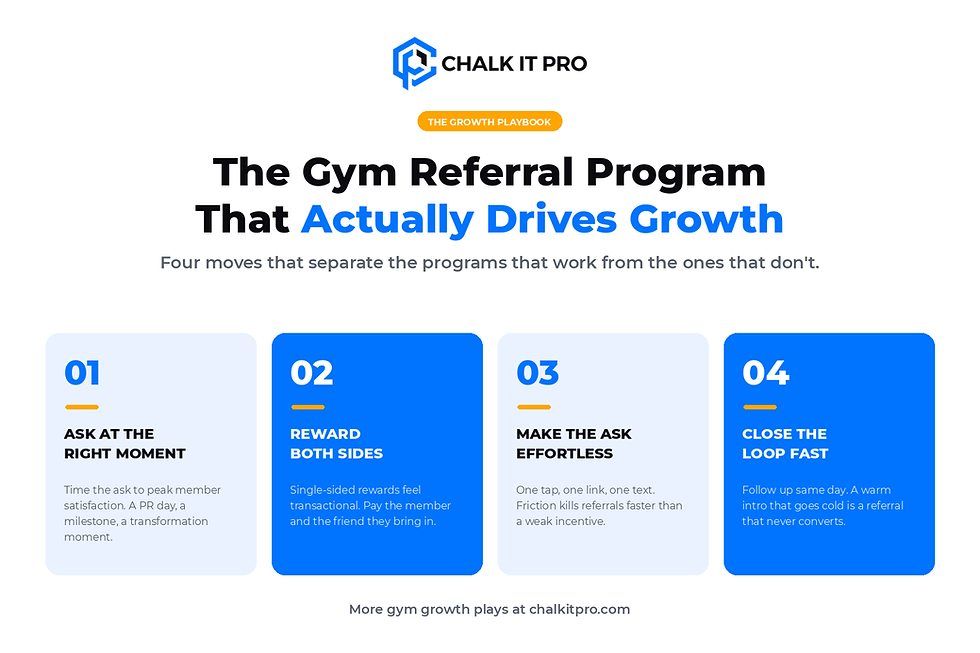
• Stopping at the form fill. The form fill is the start of the relationship, not the end. The gyms that win follow up within five minutes.
• Not tracking the funnel. If you can't tell me your cost per lead, your lead-to-trial rate, and your trial-to-paid rate, you're flying blind. Pick a tool that gives you visibility.
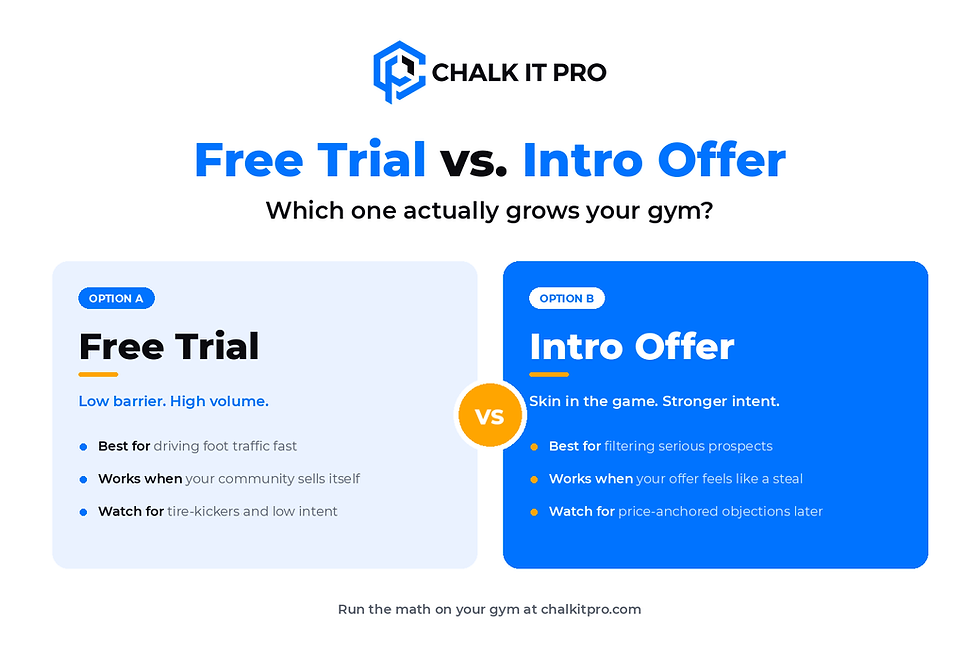
• Building offers that attract the wrong people. A "free month" offer attracts people who want a free month. A paid intro offer attracts people who are serious. Charge for the trial.
The role of software in gym lead generation
You can run a gym pipeline manually if you have 20 leads a month. You cannot run it manually if you have 80. At some point, the spreadsheets and the sticky notes break down and you start losing leads in the cracks.
Modern gym management software handles the four jobs that humans can't do reliably at scale: capturing leads from every channel into one place, sending the first follow-up within seconds, tagging leads by source and stage, and escalating from automated message to human conversation at the right moment.
Chalk It Pro wants to help you streamline your operations, cutdown on your overhead and give your members a great user experience. Our platform is a representation of your business and that's not lost on us. With me being an active gym owner, these things are important to me and I know they bring value to you as well.
How to get started this week
1. Audit your current pipeline. Where are your leads coming from? What's your cost per lead by channel? What's your conversion rate from lead to member?
2. Pick two attract channels and commit to them for 90 days. Stop spreading attention across five channels you're running at 30 percent each.
3. Build (or rebuild) your nurture sequence. The first message goes within five minutes. The second within 24 hours. The third within 72 hours.
4. Define your conversion offer. Free trial or paid intro. Pick one and stand behind it.
5. Track three numbers weekly: leads in, leads to trials, trials to paid. If you can't track them, you can't improve them.
Frequently Asked Questions
What is the average cost to acquire a gym member in 2026?
Cost per acquired gym member averages $80 to $150 in most markets, though it varies widely by channel and gym type. Member referrals run as low as $20 per acquired member. Paid social ads typically land between $100 and $250 per acquired member, depending on the offer and the follow-up system.
How many leads does a boutique gym need per month?
Most boutique gyms need 20 to 40 qualified leads per month to maintain healthy growth. At a 20 to 30 percent conversion rate, that delivers 4 to 12 new paid members per month. Lower conversion rates require higher lead volume to hit the same growth.
What's the difference between a lead and a prospect for a gym?
A lead is anyone who has given you their contact information. A prospect is a qualified lead who has shown intent (booked an intro, attended a trial class, or asked about pricing). Both are part of the same funnel, but they require different follow-up.
Do gym ads still work on Facebook and Instagram in 2026?
Yes, but the model has changed. Cold ads with weak offers and no follow-up rarely break even. Ads paired with a strong intro offer, an automated nurture sequence, and a defined sales conversation still produce reliable results for boutique gyms.
What's the best lead source for a new gym?
For a gym in its first 18 months, member referrals plus paid social ads are the fastest combination. Local SEO matters but takes 3 to 6 months to deliver leads, which is too slow for a gym still building its base.
How fast should I follow up with a gym lead?
Within five minutes of opt-in for the first touch. Leads that get a response within five minutes are roughly 8 times more likely to convert than leads that wait an hour. Automation makes this possible without burning out your front desk.
Ready to see what's possible? We built Chalk It Pro to handle your full staff and member journey in one platform. It doesn't cost anything to check out the platform and see how it can help your business. Let's book a demo and you can chat directly with me, Nate Steele at www.chalkitpro.com/bookdemo |
About the Author
Nate Steele is the co-founder and CEO of Chalk It Pro and the owner of CrossFit 630 in Naperville, IL. He built Chalk It Pro because he was tired of running his gym on four different tools that didn't talk to each other. He still coaches every week.