How to Reduce Gym Member Churn by 30% in 90 Days

The Silent Revenue Killer
Most gym owners focus on getting new members through the door. That makes sense. Growth is exciting. But for every member you acquire, there's a number most people don't track closely enough: how many members you're losing every month.
The average micro-gym loses between 3% and 5% of its members every month. At 150 members, that's 5 to 8 people walking out every 30 days. Over a year, that's 60 to 90 members you need to replace just to stay flat. At $150 per month per member, that's $9,000 to $13,500 in annual revenue walking out the door.
Reducing churn by even a third changes the economics of your gym dramatically. Here's how the gyms with the lowest churn rates actually do it.
Understand the 90-Day Danger Zone
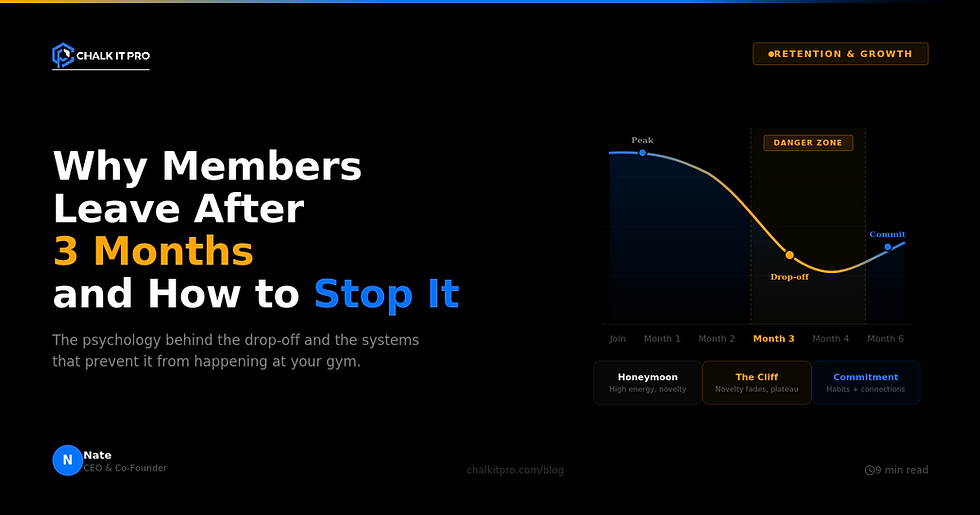
The data is consistent across gym types: the majority of member cancellations happen in the first 90 days. This is the honeymoon-to-reality transition. The initial excitement of joining fades, the novelty wears off, and if a member hasn't formed habits and connections by day 90, the odds of them leaving spike sharply.
Your first 90 days with a new member aren't just an onboarding period. They're the make-or-break window for the lifetime of that membership. Everything you do to reduce churn should disproportionately focus on this period.
Strategy 1: Build a Real Onboarding Flow
Most gyms welcome new members and then leave them to figure things out. That's not onboarding. That's hoping for the best. A real onboarding flow is a structured sequence of touchpoints that runs automatically over the first 30 to 60 days.
Week one: a welcome message from the owner and a personal introduction to the coaching staff. Week two: a check-in asking how the first few classes went and if they have questions about the programming. Week three: an invitation to a community event or a gym challenge. Week four: a progress acknowledgment noting what they've accomplished and encouraging them to set a 90-day goal.
These touchpoints can be automated through your gym management software. The member feels personally cared for. You don't have to remember to send each message manually. The key is that the communication feels genuine, not like a generic drip campaign.
Strategy 2: Make Community Connection Automatic
The number one predictor of long-term retention isn't fitness results. It's social connection. Members who form friendships at the gym are dramatically more likely to stay than those who show up, work out, and leave without interacting.
You can't force friendships, but you can create the conditions for them. In-app community features like forums, channels, and social feeds give members a space to interact outside of class. Challenges and partner workouts create shared experiences. Member spotlights and celebrations make people feel seen.
If your gym software includes community tools, use them aggressively during the first 90 days. If it doesn't, you're relying on Facebook groups and organic in-gym interaction, which works for some members but misses many others.
Strategy 3: Track Attendance, Not Just Payments
A member who's paying but not attending is a cancellation waiting to happen. The warning signs are almost always visible in the attendance data weeks before the cancellation request arrives.
Set up attendance tracking alerts. If a member goes from three visits a week to one, that's a flag. If a member misses two full weeks, that's an urgent flag. The fastest intervention is often the simplest: a genuine personal message from a coach checking in. Not a sales pitch. Not a guilt trip. Just a human being asking if everything's okay.
The gyms that do this well catch 50% or more of at-risk members before they leave. The gyms that don't do it at all find out when the cancellation email arrives.
Strategy 4: Give Members Visible Progress
People stay when they can see they're getting somewhere. This is why workout tracking matters for retention, not just for performance. When a member can look back at their first month and see that their deadlift went up by 20 pounds, their run time improved, or they completed more rounds in a benchmark workout, they have tangible proof that what they're doing is working.
Make progress visible. Celebrate PRs. Use leaderboards to create friendly competition. Send automated milestone messages when a member hits 50, 100, or 200 workouts. These aren't just feel-good moments. They're retention mechanisms that anchor the member's identity to your gym.
Strategy 5: Automate the Boring but Critical Tasks
Failed payment follow-up. Class reminder notifications. Birthday messages. Anniversary acknowledgments. Reactivation outreach to paused members. None of these are exciting, and none of them should require your personal attention every time they happen.
Automation handles the volume. It ensures that no member falls through the cracks because you were busy coaching a class when their payment failed or because you forgot that today marks their one-year anniversary. These small touches compound over time into a member experience that feels attentive and personal, even though the system is doing most of the work.
Measuring the Impact
Track your monthly churn rate as a percentage: members lost divided by total members at the start of the month. Track it consistently over 90 days after implementing these strategies. A 30% reduction in churn, from 5% monthly to 3.5%, may not sound dramatic, but it compounds. Over 12 months, the difference is 18 fewer cancellations for a 150-member gym. At $150 per month, that's $32,400 in preserved annual revenue. All from keeping people who already walked through your door.
Ready to see what one platform can do for your gym?
Book a demo at chalkitpro.com/bookdemo